Tag: career shift

  • Starting Over: On Being a Beginner Again

    There’s a particular discomfort in being competent at one thing and incompetent at another. For years, I knew what I was doing. I could walk into a room and trust my training, my experience, my reflexes. That certainty shaped not just my work—it shaped how I moved through the world as a physician.

    Then everything shifted.

    Burnout doesn’t always announce itself as crisis. Sometimes it whispers through the gaps: the metrics that stopped meaning anything, the efficiency that became its own tyranny, the identity so fused with doing that stopping felt like disappearing. So I made a change. Not away from medicine—toward something different within it.

    Now I’m learning a new space, and I’m learning something unexpected: my expertise and my beginner status don’t cancel each other out. They coexist, awkwardly, honestly.

    The productivity culture I built my career in—the one that equated speed with competence, output with worth, constant optimization with purpose—that’s still in my bones. But this transition is asking me to examine it. Not to abandon rigor or precision. To ask instead: What if competence looks different here? What if it’s slower, or quieter, or measured in ways I haven’t learned yet?

    This is uncomfortable because it means tolerating uncertainty in a field that trained me to eliminate it. It means showing up as a learner in spaces where I’m used to being the authority. It means renegotiating my own sense of what it means to be good at what I do.

    I don’t have answers yet. What I have are questions—the kind that sit with you, that shift how you see your own transition, whether you’re in it now or contemplating it.


    Three Questions for Reflection

    T1: What parts of your expertise are actually portable, and which ones are tied to the identity you’re leaving behind?

    It sounds simple until you sit with it. The clinical knowledge transfers; the “I know how to think under pressure” transfers. But the part of your identity that drew energy from being the expert in the room? That needs conscious release. What would it feel like to contribute your knowledge without needing it to define you?

    T2: When you strip away the productivity metrics—the patient volume, the publications, the procedural counts—how do you actually know if you’re doing well?

    This one lives in my body. I don’t have the old feedback loops anymore. No one’s tracking my throughput. That should feel liberating. Sometimes it just feels disorienting. What becomes your internal compass when the external metrics go quiet? And can you trust it?

    T3: How do you show up differently to colleagues, patients, and yourself when you’re not performing certainty?

    Being a beginner means admitting what you don’t know. In medicine, we’re trained to hide that. But what if vulnerability—the willingness to say “I’m learning this”—actually deepens trust rather than undermining it? How does that change your relationships?


    These aren’t rhetorical. They’re the ones I’m sitting with. I’m curious what lands for you—what resonates, what pushes back, what you’d ask differently.

    Drop your reflections in the replies. Or sit with them privately. Either way, you’re not alone in this.

    Inviting everyone to the #HealthXPh Chat this Saturday, April 25, 2026, 9–10 PM MlaTime. Let’s have the conversation medicine rarely makes space for.


  • The Questions We Keep Editing Out

    The Questions We Keep Editing Out

    A Mid-Career Shift in Healthcare — Part II


    Part I of this conversation was about the practical side of career change — credentials, finances, identity, the mechanics of letting go. The response from colleagues was revealing. Many recognized themselves in the questions.

    But some replies hit me deeply. They pointed at something I often stepped around.

    So Part II goes somewhere different. Not just the logistics of career transition — but the emotional ground underneath it. The questions most of us keep editing out of the conversation.

    I wonder if any of these feel familiar.


    T1: Are we burned out — or have we just gotten very good at calling it something else?

    Many of us who reach this career crossroads say the same thing almost reflexively: “It’s not burnout.”

    And maybe that’s true. But it’s worth asking — is that a clinical distinction, or a professional one? Are we drawing a line between ourselves and a diagnosis that carries more stigma than we’re willing to claim?

    There’s a particular kind of exhaustion that high-functioning physicians get remarkably good at hiding — from colleagues, from patients, and most efficiently, from themselves. The external markers of competence stay intact long after the internal ones have quietly eroded. You keep performing. You keep delivering. Nobody sees it because you’ve made not being seen part of the system.

    The clinical literature draws a useful distinction here. Some researchers argue that what many physicians experience isn’t burnout at all — it’s moral injury: the damage done not by too much work, but by being repeatedly asked to act against your own values within a system you cannot fix.[1] In Philippine healthcare, that distinction matters. Many of us aren’t simply tired. We are tired and quietly grieving the gap between the medicine we trained to practice and the medicine the system allows us to give.

    So the question isn’t just are you burned out?

    The real question is: have we, as a profession, ever given ourselves an honest language for what this work actually does to us over twenty years?


    T2: What did the people closest to us quietly lose while we were busy building our careers?

    This one rarely makes it into professional conversations. It probably should.

    The careers most of us built in medicine — the practices, the titles, the institutional roles — were also, quietly, a long series of choices about where we put our attention. Evenings at the hospital instead of at home. Weekends consumed by committees that no longer exist. A version of presence that looked like being there but wasn’t, not really.

    The people around us — families, partners, children — learned to work around our schedules the way water works around a rock. Without complaint, mostly. Without drama. Just quietly reshaping themselves around our absence.

    We don’t talk about this in medical culture. There’s no CME unit for it. The unspoken assumption is that the people who love us understand — that the sacrifice is shared and accepted, that the career justifies the cost.

    But does it? And have we ever actually asked?


    T3: Was the career we built genuinely ours — or a script we inherited and never questioned?

    This might be the hardest question of all. And I suspect it’s the one most of us never ask — not because we’re incurious, but because the system never slows down long enough to let us.

    Medicine in the Philippines has a very clear script for what a successful career looks like. Specialty training. Fellowship. Private practice. Hospital affiliations. Committees. Leadership roles. The ladder is visible, well-lit, and reinforced at every rung. Families celebrate each step. Colleagues measure themselves against each other. Institutions need you to keep climbing.

    At no point in that process does anyone sit you down and ask: Is this what you actually want? Or is this what you’ve been taught to want?

    The philosopher Charles Taylor wrote about the difference between living by your own genuine choices and living by what others recognize as a good life.[2] Most physicians never get the space to find out which one they’ve been doing. The system is too busy, too demanding, and too good at making busyness feel like purpose.

    Some of what we built was genuinely ours. The clinical work. The teaching. The deep satisfaction of a difficult case managed well. That part most of us don’t regret.

    But some of it — the volume, the titles, the visible markers of institutional standing — were those ever really chosen? Or were they handed to us before we were old enough to question them?


    Why These Questions Matter

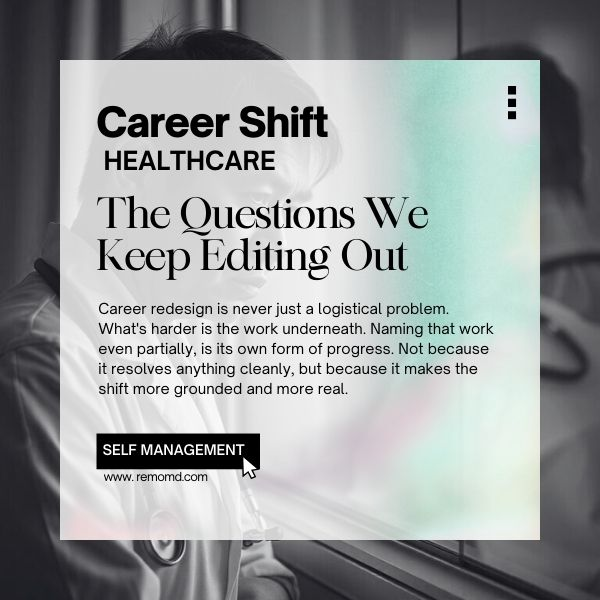
    Career redesign — in medicine or anywhere — is never just a logistical problem. The paperwork, the certifications, the financial planning: those are the easier parts. What’s harder is the work underneath. The assumptions we never examined. The costs we deferred and are only now beginning to count. The definitions of success we accepted without ever really auditing them.

    Naming that work honestly — even partially, even in public — is its own form of progress. Not because it resolves anything cleanly, but because it makes the shift more grounded and more real.

    What I’m most curious about is whether these questions land with colleagues at a similar stage — or whether they feel like the wrong questions entirely. Both reactions are worth hearing.

    If any of this hit somewhere real for you, I’d genuinely like to know.

    Join the #HealthXPh Chat this Saturday, February 14, 2026, 9–10 PM Manila Time. Let’s have the conversation medicine rarely makes space for.


    References

    [1] Talbot SG, Dean W. Physicians aren’t ‘burning out.’ They’re suffering from moral injury. STAT News. 2018. https://www.statnews.com/2018/07/26/physicians-not-burning-out-they-are-suffering-moral-injury

    [2] Taylor C. The Ethics of Authenticity. Harvard University Press; 1991.


    Part I: A Mid-Career Question I Can’t Avoid Anymore

  • Finding Your Second Act: A Mid-Career Shift in Philippine Healthcare

    Finding Your Second Act: A Mid-Career Shift in Philippine Healthcare

    After two decades in orthopedic surgery and healthcare leadership, I found myself at a crossroads that many of us in Philippine healthcare eventually face. The administrative burden, the constant demands, the physical and mental exhaustion had accumulated. Something had to change.

    Last year, I stepped away from several major professional commitments. Now, I’m deliberately shifting toward sports medicine, wilderness medicine, and lifestyle medicine—fields that align with what matters most to me: health, fitness, family, and the outdoors. I’m returning to writing, landscape photography, hiking, and running—the things that make me feel alive.

    This transition has taught me that mid-career shifts in our healthcare system aren’t just about changing specialties. They’re about reclaiming purpose and redefining what success means at this stage of our professional lives.

    I’d like to open up a conversation around three questions that I think are central to anyone considering a similar path:

    1. How do you know when it’s time to shift, and what are the practical first steps?

    The decision to shift isn’t usually sudden—it builds over time. For me, the signs were clear: physical and mental exhaustion that rest couldn’t fix, a growing disconnect between my daily work and what energized me, and the realization that the roles that once felt like achievements now felt like obligations.

    Research on physician burnout shows that these feelings are common and consequential. Studies indicate that physician burnout rates range from 35-54% globally, with administrative burden being a leading contributor.[1] The phenomenon often peaks in mid-career when the cumulative stress of clinical practice, administrative duties, and work-life imbalance reaches critical levels.[2]

    But recognizing the need is different from taking action. In our setting, practical first steps might include: identifying which aspects of your current practice you can gradually reduce or delegate, exploring adjacent fields where your existing credentials and experience create natural bridges (for me, orthopedics to sports medicine made sense), and honestly assessing your financial runway—especially important in private practice where income can be variable.

    The Philippine healthcare landscape has unique challenges: our professional networks are tight-knit (both an advantage and a pressure), our medical societies have specific certification pathways that may require additional training, and our reimbursement systems—whether PhilHealth, HMOs, or out-of-pocket—vary significantly across specialties.[3]

    2. How do you manage the financial and identity crisis of letting go?

    This might be the most anxiety-inducing aspect of any mid-career shift. After twenty-plus years, you’ve built a reputation, a patient base, a reliable income. Walking away from that—even partially—feels risky.

    Financial planning becomes critical. I had to consider: What are my fixed expenses? How much income do I absolutely need versus what I’ve grown accustomed to? Can I phase the transition rather than make a sudden leap? Do I have passive income streams or investments that provide a buffer?

    Literature on career transitions emphasizes the importance of financial preparation, typically recommending 6-12 months of living expenses saved before making significant career changes, though this varies based on individual circumstances.[4] For physicians in the Philippines, where private practice income can fluctuate and social safety nets are limited compared to other countries, this buffer becomes even more crucial.

    The professional identity question runs deeper. When you’ve built your identity around specific roles and titles, letting go of them can feel like losing part of yourself. Research on professional identity transitions shows that physicians often experience grief and loss when stepping away from established roles, as medical identity becomes deeply intertwined with personal identity.[5] I’m learning that this is actually an opportunity—to be known for what I’m passionate about now, rather than what I’ve achieved in the past.

    Our colleagues’ perceptions matter in Philippine medical circles. Some may see a shift as stepping down or giving up. Reframing it—for yourself and others—as stepping toward something more aligned with your current life stage can help manage those conversations.

    3. How do you start over as a beginner while still being the expert?

    This is where the rubber meets the road. You can’t just declare yourself a sports medicine or lifestyle medicine physician—you need the knowledge, the skills, and the credentials that our system recognizes.

    For me, this means pursuing additional training and certifications in sports medicine and wilderness medicine while still maintaining my orthopedic practice. It’s a juggling act. The strategy I’m using: start with shorter courses and certifications that complement my existing expertise, build a portfolio gradually rather than trying to master everything at once, and leverage my orthopedic background where it naturally overlaps with sports medicine.

    Sports medicine certifications are available through several pathways including the Philippine Academy of Family Physicians Sports Medicine Diplomate program and international certifications from organizations like the American College of Sports Medicine (ACSM).[6] Wilderness medicine training is offered by institutions like the Wilderness Medical Society and has growing relevance in the Philippines given our archipelagic geography and adventure tourism industry.[7]

    Credibility takes time. I’m accepting that I’ll be a beginner again in some areas, which is humbling after being the expert for so long. But there’s something energizing about learning with fresh eyes, about rediscovering the curiosity that brought me to medicine in the first place.

    The concept of “beginner’s mind” in professional development—approaching new learning with openness and enthusiasm despite prior expertise—has been shown to enhance both learning outcomes and professional satisfaction in mid-career transitions.[8]

    The local medical education landscape offers opportunities—fellowships, diploma courses, international certifications that are recognized here. The challenge is finding programs that accommodate working physicians rather than requiring full-time commitment.


    These questions don’t have simple answers, and I’m still navigating this transition myself. But I’m convinced that mid-career shifts in Philippine healthcare need to be discussed more openly. We have a generation of physicians approaching their 50s and 60s who built their careers in one era of medicine and are now asking what the next chapter should look like.

    I’d love to hear from others who’ve made similar transitions or are considering them. What worked? What didn’t? What advice would you give to physicians standing at this crossroads?

    The goal isn’t to abandon what we’ve built but to evolve it into something sustainable and meaningful for this next stage of our lives and careers.


    References

    [1] West CP, Dyrbye LN, Shanafelt TD. Physician burnout: contributors, consequences and solutions. J Intern Med. 2018;283(6):516-529. Available at: https://onlinelibrary.wiley.com/doi/10.1111/joim.12752

    [2] Dyrbye LN, Varkey P, Boone SL, Satele DV, Sloan JA, Shanafelt TD. Physician satisfaction and burnout at different career stages. Mayo Clin Proc. 2013;88(12):1358-1367.

    [3] Dayrit MM, Lagrada LP, Picazo OF, Pons MC, Villaverde MC. The Philippines Health System Review. Health Systems in Transition, Vol. 8 No. 2 2018. WHO Regional Office for the Western Pacific. Available at: https://iris.who.int/handle/10665/274579

    [4] Ibarra H. Working Identity: Unconventional Strategies for Reinventing Your Career. Harvard Business School Press; 2003.

    [5] Monrouxe LV. Identity, identification and medical education: why should we care? Med Educ. 2010;44(1):40-49.

    [6] American College of Sports Medicine. ACSM Certification. Available at: https://www.acsm.org/get-stay-certified/get-certified

    [7] Wilderness Medical Society. Wilderness Medicine Education. Available at: https://wms.org/education

    [8] Langer EJ. The Power of Mindful Learning. Da Capo Press; 1997.