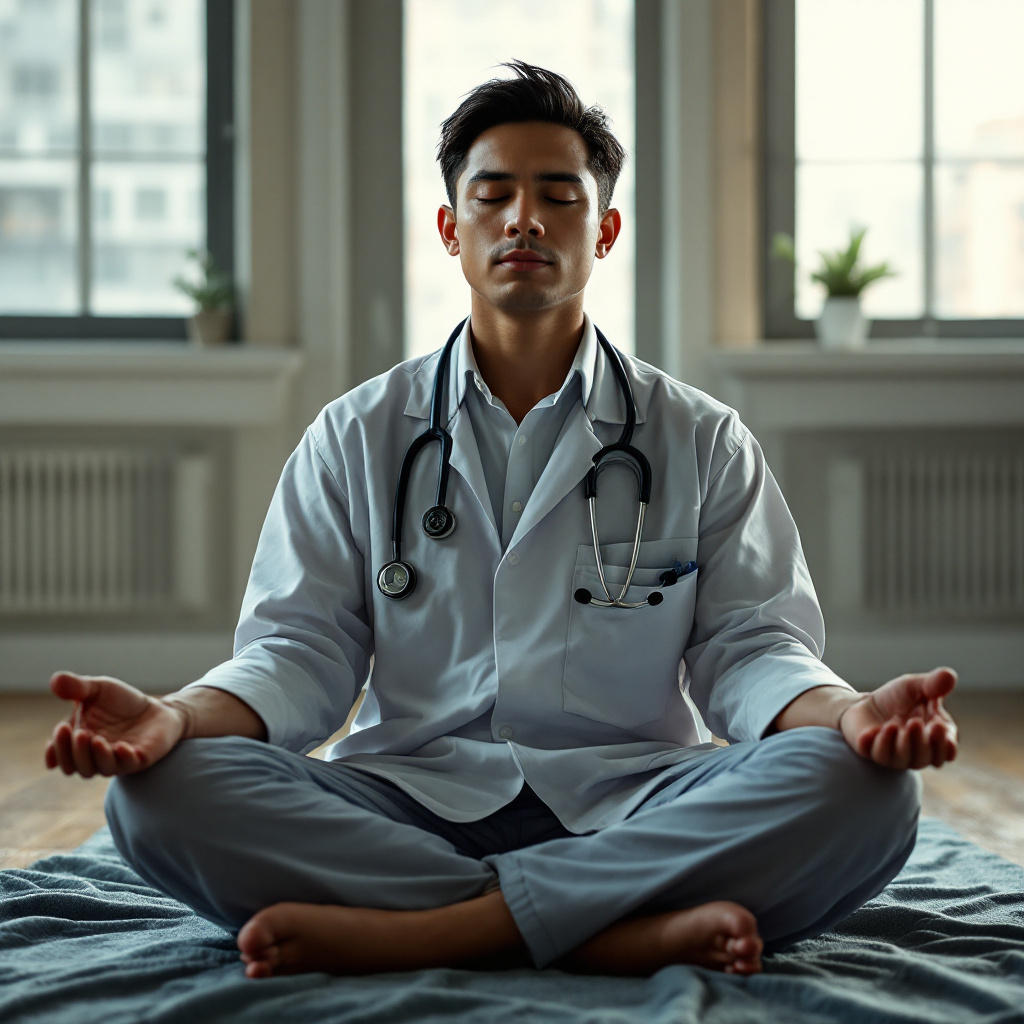
Tag: meditation

  • Mindfulness Based Interventions For Healthcare Professionals

    Mindfulness Based Interventions For Healthcare Professionals

    Healthcare professionals frequently experience stress and burnout in their work environment. Unaddressed, such stress and burnout sometimes lead to physical and mental health problems, including anxiety, depression, diabetes, fatigue, heart disease, hypertension, insomnia and obesity Burnout amongst HCPs has also been associated with reduced job satisfaction and negative patient outcomes, like reduced patient satisfaction and increased work errors.

    There is a growing evidence suggesting that mindfulness-based interventions (MBIs) can help decrease stress and burnout experienced amongst HCPs, increasing job satisfaction levels and improving an aspect of patient outcomes (Escuriex and Labbe 2011; Irving et al. 2009; Shanafelt et al. 2009).

    Kabat- Zin (1994) defines mindfulness as the quality of awareness that occurs through intentionally focusing on present moment experiences in an accepting and non-judgemental manner. It is fast becoming a popular psychological stress reduction intervention mong HCPs. Mindfulness and Mindfulness Based Interventions (MBIs) “causes a positive shift in perspective and an ability to objectively view one’s life experiences” often referred to as “decentering” MBIs also causes “Reperceiving” which facilitates an individual’s ability to observe their thoughts and feelings with greater clarity.

    In this edition of #HealthXPh chat, I would like to know the practice and impact of mindfulness and mindfulness based interventions among healthcare professionals.

    T1. Do you practice mindfulness or MBIs at work? Why or why not?

    I started practicing mindfulness sometime in 2012, hoping to reduce stress and focus my attention to work. I was introduced to the guided meditation technique in an app called “Headspace”. Of course, I really don’t know if there was any effect on me at all (let alone my work) but I liked the “decentering” periods that took me off my busy schedule.

    T2. What are the benefits or challenges of practicing mindfulness or MBIs at work?

    It took me awhile to notice the impact of practicing mindfulness in my life. The irony of course is that it’s rarely me who did notice, but my family, friends, or colleagues and you guess, patients. Sometimes you barely notice the impact at all. But, I think with MBIs, I was able to stretch my patience, self regulate emotions and empathize in a more compassionate way. In a very busy and hectic work environment, the challenge was finding time and consistently doing mindfulness.

    T3. Would you recommend mindfulness or MBIs to colleagues, friends or even patients?Why or Why not?

    I have recommended MBIs to a number of “stressed” and “burned out” friends and colleagues. I have recommended it to a few patients who asked and were interested. I have yet to fully understand some of its impact on others, but i do get self report of “better, optimistic attitude’, “non judgmental” “anger control” and varying degrees of focused attention.

    Today I am continually practicing mindfulness based meditation- at home, work, during travel/commute and most especially when I am outdoors. It is not exactly a glorious, effortless of a habit, but even with the meditative breathing alone, I can “sense calm” in times when I’m probably burned or something.

  • Ten daily routines that help me balance my professional and personal lives

    “You don’t find time to do all these stuff outside of your physician’s life. You make time” as the cliche goes.

    Nowadays, I shy away from giving personal advices but instead “listen” until the advise seeker process his or her own personal thoughts and strategy. Knowing how different life circumstances are, my “personal” advices rarely work on everyone else on this planet.

    Yet there is a personal strategy I use everyday (or at least try to) in finding balance to the “tug of war” of my personal and professional life. Nothing in this strategy is original to me. I got most of it from people I look up to or books that I read.  The components of this personal strategy are mostly life tweaks, or hacks, a product of  daily hit and miss experimentations.  So if you are looking for a template to develop your own “personal” strategy, have at look at my daily routines. Pick the ones that would work for you or better yet, tweak to customize your own strategy. Enjoy!

    1. I meditate for 15-20 minutes daily. There’s evidence proving the benefits of mindfulness and meditation. My day would be a bit calmer, tasks and goals clearer and I react less to outside trivial triggers. The goal here is really not to create a state of mind and being but just to be self aware and mindful of everything that comes into mind. Consistency is key for me. The more I do it everyday, the greater is the benefit for me. I use a guided meditation app called Headspace.
    2. I journal everyday. Journalling makes my tasks and goal for the day clearer and simpler. My morning journal also centers on what not to do to weed out unnecessary stuff on my schedule. Journalling triggers a good portion of creative inspiration in me.  At night, journalling gives a sense of fulfillment for completing  small but meaningful tasks . My format is basically a tweaked 5 minute journalling although doodling sometimes eat another good 10 minutes of my time.

      An empty example of my daily journal.
    3. I talk to mentors as often as I could.  I have a set of personal and professional board of advisers I call to for advice. These are people who’s thoughts and advices on subjects add value to my my decision making process. Sometimes, “talking” means reading self help, life hack books to pick out skill sets or strategies and then customise it for my own purposes.
    4. I connect with my advocacies. I knew only a handful of lucky people who’s advocacy exactly coincides with a career that put food on the table. Mine is far from such although I strive daily to align my advocacies and work. An advocacy (like our at #HealthXPh) is self fulfilling while achievement is usually associated with “wins” in our professional lives. Advocacies also steer me directly to an aspirational self “who changes the world” for the better.
    5. I practice my hobby, everyday. Hobbies are not just a distraction but a life essential for me. It is my ultimate source for the creative juice for a life I designed for myself.  I love photography and hiking as well as blogging. So I invest time and money modestly in these to force myself into consistently practicing it. I have to or else my professional life will eat up more time of my daily schedule.
    6. I network with friends outside my professional circle. A nurturing community outside my professional circle is an essential for me. I found out that most of the personal “help” I had in the past was from people outside my professional circle. This network of friends are also a source of life hacks I listen to and emulate.
    7. I read books. Goes without saying that I consider books as mentors too. It is my gateway to new and exciting world beyond what my mind could possibly ponder alone. A good 15-30 minutes or even an hour is spent on reading pages of one or two books, then another 15 minutes for my “marginalia” or very short personal summaries of the pages I read. I also horde books. It’s a screaming bargain!

      Book hoarding for later read.
    8. I aggressively protect my personal and family time. Another very important non negotiable for me. I know this is very hard for most of us in the medical profession but I started out focusing on small day to day opportunities of saying “no” when my personal life requires me to. Key is being consistent on what constitute personal or family time. Sometimes industry will hate me for having such a immovable stance on this, but I felt somehow they’d respect me for doing so.
    9. I consciously build a productivity based and proactive professional practice rather than a reactive one. I can’t work effectively or productively for more than 4 hours each day, except while doing surgeries. I found this primarily beneficial to my patients, who deserved the best and most productive of my time. This translates to less income for me but greater non tangible benefits for my professional and personal life.
    10. I exercise 15 minutes each day. The benefits of regular, consistent exercise is well documented. Doesn’t matter what form of exercise is available to me so long as I move. I sometimes dance when no one else is looking. 🙂

    Well wait you might ask what the heck am I enumerating these for? First,  I specifically mentioned  “processes” or daily routines that help me “win” the balance to a  daily tug of war of personal and professional lives.  These routines help me make better choices or at least avoid the worst ones. Do I have proof that these work? On a personal level, yes or at least I felt it’s working for me. I think finding the balance in our life starts with the small, daily processes and decisions we make. So in this case, to win big, I start with the daily struggle and work from there.

    I hope you will find this useful. Feel free to comment below for your thoughts.