Tag: physicians

  • The Questions We Keep Editing Out

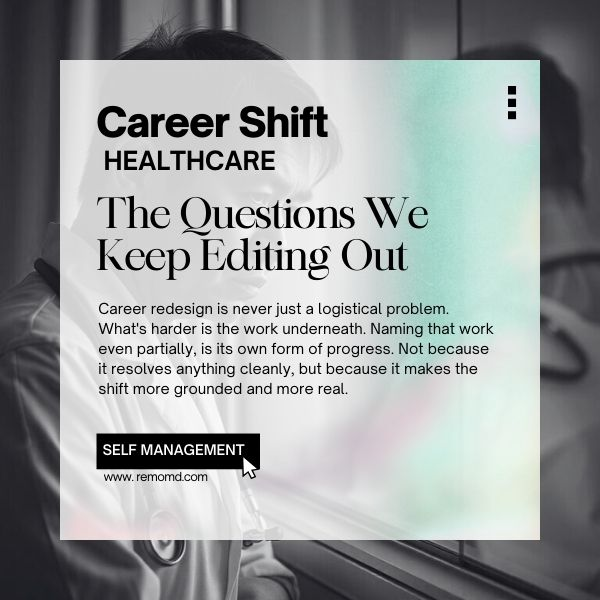
    The Questions We Keep Editing Out

    A Mid-Career Shift in Healthcare — Part II


    Part I of this conversation was about the practical side of career change — credentials, finances, identity, the mechanics of letting go. The response from colleagues was revealing. Many recognized themselves in the questions.

    But some replies hit me deeply. They pointed at something I often stepped around.

    So Part II goes somewhere different. Not just the logistics of career transition — but the emotional ground underneath it. The questions most of us keep editing out of the conversation.

    I wonder if any of these feel familiar.


    T1: Are we burned out — or have we just gotten very good at calling it something else?

    Many of us who reach this career crossroads say the same thing almost reflexively: “It’s not burnout.”

    And maybe that’s true. But it’s worth asking — is that a clinical distinction, or a professional one? Are we drawing a line between ourselves and a diagnosis that carries more stigma than we’re willing to claim?

    There’s a particular kind of exhaustion that high-functioning physicians get remarkably good at hiding — from colleagues, from patients, and most efficiently, from themselves. The external markers of competence stay intact long after the internal ones have quietly eroded. You keep performing. You keep delivering. Nobody sees it because you’ve made not being seen part of the system.

    The clinical literature draws a useful distinction here. Some researchers argue that what many physicians experience isn’t burnout at all — it’s moral injury: the damage done not by too much work, but by being repeatedly asked to act against your own values within a system you cannot fix.[1] In Philippine healthcare, that distinction matters. Many of us aren’t simply tired. We are tired and quietly grieving the gap between the medicine we trained to practice and the medicine the system allows us to give.

    So the question isn’t just are you burned out?

    The real question is: have we, as a profession, ever given ourselves an honest language for what this work actually does to us over twenty years?


    T2: What did the people closest to us quietly lose while we were busy building our careers?

    This one rarely makes it into professional conversations. It probably should.

    The careers most of us built in medicine — the practices, the titles, the institutional roles — were also, quietly, a long series of choices about where we put our attention. Evenings at the hospital instead of at home. Weekends consumed by committees that no longer exist. A version of presence that looked like being there but wasn’t, not really.

    The people around us — families, partners, children — learned to work around our schedules the way water works around a rock. Without complaint, mostly. Without drama. Just quietly reshaping themselves around our absence.

    We don’t talk about this in medical culture. There’s no CME unit for it. The unspoken assumption is that the people who love us understand — that the sacrifice is shared and accepted, that the career justifies the cost.

    But does it? And have we ever actually asked?


    T3: Was the career we built genuinely ours — or a script we inherited and never questioned?

    This might be the hardest question of all. And I suspect it’s the one most of us never ask — not because we’re incurious, but because the system never slows down long enough to let us.

    Medicine in the Philippines has a very clear script for what a successful career looks like. Specialty training. Fellowship. Private practice. Hospital affiliations. Committees. Leadership roles. The ladder is visible, well-lit, and reinforced at every rung. Families celebrate each step. Colleagues measure themselves against each other. Institutions need you to keep climbing.

    At no point in that process does anyone sit you down and ask: Is this what you actually want? Or is this what you’ve been taught to want?

    The philosopher Charles Taylor wrote about the difference between living by your own genuine choices and living by what others recognize as a good life.[2] Most physicians never get the space to find out which one they’ve been doing. The system is too busy, too demanding, and too good at making busyness feel like purpose.

    Some of what we built was genuinely ours. The clinical work. The teaching. The deep satisfaction of a difficult case managed well. That part most of us don’t regret.

    But some of it — the volume, the titles, the visible markers of institutional standing — were those ever really chosen? Or were they handed to us before we were old enough to question them?


    Why These Questions Matter

    Career redesign — in medicine or anywhere — is never just a logistical problem. The paperwork, the certifications, the financial planning: those are the easier parts. What’s harder is the work underneath. The assumptions we never examined. The costs we deferred and are only now beginning to count. The definitions of success we accepted without ever really auditing them.

    Naming that work honestly — even partially, even in public — is its own form of progress. Not because it resolves anything cleanly, but because it makes the shift more grounded and more real.

    What I’m most curious about is whether these questions land with colleagues at a similar stage — or whether they feel like the wrong questions entirely. Both reactions are worth hearing.

    If any of this hit somewhere real for you, I’d genuinely like to know.

    Join the #HealthXPh Chat this Saturday, February 14, 2026, 9–10 PM Manila Time. Let’s have the conversation medicine rarely makes space for.


    References

    [1] Talbot SG, Dean W. Physicians aren’t ‘burning out.’ They’re suffering from moral injury. STAT News. 2018. https://www.statnews.com/2018/07/26/physicians-not-burning-out-they-are-suffering-moral-injury

    [2] Taylor C. The Ethics of Authenticity. Harvard University Press; 1991.


    Part I: A Mid-Career Question I Can’t Avoid Anymore

  • Managing Your Doctor Self

    Managing Your Doctor Self

    I’m having a conversation with a colleague when our talk drifted to how are we managing our lives. “How are you managing your physician life?” I asked. I am in the middle of pivoting professional directions, easing out on one an aspect of my physician life. So, maybe I could get an insight into how they balance all these amidst their very busy practice and learn something I could apply in my own life context.

    “You mean our academic, clinical and administrative life as a doctor? or all of that plus our family??!” She jokingly scoffed. The couple are surgeons, both taking masters degree, both professors at a school of medicine, have very vibrant surgical practice spanning several hospitals in the locality. “Plus,” she added, ” we have two adolescents who often ask about their whereabouts but eventually understood their professional and family “routines”. “We’re juggling, surviving and giving up something for another thing ! ” she continued. “How?”, I asked. While we were engaging in a lively discussion about how we manage our physician lives, it hit me. “Did they teach us managing ourselves in med school or training??” “No” was the unanimous answer. It was all a trial and error sort of learning. Imagine a physician, a noble profession, trained to treat, lead and managed people wasn’t trained to manage themselves.

    T1. Should physicians be “taught” how to manage themselves?

    The five star physician goal of WHO for any medical curriculum comes to mind. But nowhere you can find “manage self”. I mean sure, we’re clinical expert when managing our patients. Ironically, we were taught not to manage our own afflictions for fear of bias! Academic? thru some self directed learning maybe. How about administrative? like leaders or managers? Partly yes, but this is more on managing our patients or the community. What about formally managing our doctor self? Nada. Nitz. I went though my formal arts, humanities and social science courses in pre and med proper and that was the closes thing I could imagine to “managing oneself” I could remember. Art appreciation, really? a long shot yes.

    T2. Is there a negative impact to doctors who couldn’t manage themselves?

    Times have changed. The suicide rates for physicians is one of the highest among all professions. Apart from that, the mental health concerns among healthcare professionals are also, at all time high. Career shifts which was often unheard of in the profession, is becoming a commonality. Training institutions begrudgingly complain of resident burn out and low retention rate. This impact physician and patient relations as well as their communities of practice or training institutions. While it is rare that these would bring down the whole healthcare industry, it is disconcerting why such noble profession trained at managing others, wasn’t trained at managing their own, self. Not one physician ever thought of shifting, quitting or worst, committing suicide after med school, just because they weren’t able to “manage themselves” as doctors, academics and leaders and a family person.

    T3. What advice can you give a colleagues about managing our doctor self?

    Teach yourself how to manage your doctor self now! Learn from colleagues and mentors who went through the tough times. Take a coach, a mentor, a formal course if there are. Read a book about managing yourself even if that book is non medically related book. There’s parallelism and nuggets you can take from any other profession. If you can afford, get an assistant to manage some facets of your physicians life.

    Peter Drucker and Clayton Christensen mentioned one key ingredient of a successful professional career is that persons ability to manage oneself. I think that applies to physicians too. No amount of “field expertise” could cover up for someone’s ability to manage all facets of his or her professional and personal life.

    Join #healthxph chat on X/Twitter this Saturday April 20, 2024 PM Manila time. Don’t forget to append the hashtag #HealthXPh to you tweets during convo. See you!

  • Gratitude: The Art of Savoring.

    I was stressed this past past few weeks I finally figured in a sports injury which was supposed to be a way to de-stress my body. The many roles I acquired during the pandemic finally took its toll after almost all required physical presence and face to face activities.

    Face to face tasks demand full attention and physical presence. You cannot attend two conferences at the same time anymore or listen to two lectures on two different gadgets. It seems that, the technology enabled “always present, always available” does not hold true anymore post pandemic. It came to a frustrating point that I decided to give up one of the “roles” I took on during the pandemic. The reason? I couldn’t handle that many roles anymore, not in this post pandemic, physical presence demanding work environment. I just want to go back see and treat patients, nothing else.

    One mentor I consulted said “instead of lingering on the many difficulties this pandemic brought us, try savoring on the ones you survived- the small wins. You may have downplayed many of these wins because of the negative experience we had in this pandemic!” “You journal right? I’m sure there is a lot you can write on the gratitude corner”. He was absolutely right!

    Gratitude! I can certainly count many but why is it easier to linger on a negative experience? Medical professionals are often taught to spot uncomfortable experiences like pain, decrease range of motion or difficulty breathing. When was the last time you asked a patient “Did you have a good night sleep?” Somehow we relegated that gratitude to that small corner of our planner. We lost that art of savoring the small wins.

    “Savoring” said Daniela Ramirez Duran, is “intentionally placing our attention on positive events and prolonging the positive feelings that arise”. Duran further enumerated the many benefits of increasing savoring ability. I first encountered the word “savoring” in Christopher Peterson’s Pursuing the Good Life: 100 Reflections on Positive Psychology. Savoring: A New Model of Positive Experience by Fred B. Bryant and Joseph Veroff dug deeper into this “art” and gave practical tips applying it on our daily life. Dr. Hayley Lewis enumerated some of these tips in a sketch note below.

    I’m asking my fellow healthcare providers about the art of savoring in their daily life and how they practice gratitude in spite of the challenging grinds of the medical life. This will be the topic of our #HealthXPh chat this Saturday July 1, 2023 9PM Manila time. Here are the guide questions:

    [su_box title=”Art of Savoring among Healthcare Professionals”]
    [su_list icon=”icon: hand-o-right”]

    • T1. What are the benefits of savoring/ gratitude?
    • T2. How do you practice savoring/ gratitude?
    • T3. Do you recommend/ prescribe gratitude exercise? [/su_list] [/su_box]

      See you all this Saturday 9PM for the #HealthXPh Tweetchat!

      Image by partystock on Freepik