Tag: social media

  • Twitter, Tweets and Tweet Chats for Better Healthcare | #SocMed4MDs

    Twitter, Tweets and Tweet Chats for Better Healthcare | #SocMed4MDs

    Lifting lives, 140 characters at a time.

    ― Germany Kent

    What is Twitter?

    Twitter is a social networking, news, and microblogging service that allows you to send out short messages called “tweets”. A tweet can be text, links or any media – photos, video, or a GIF. Tweets used to be limited to 140 characters but this increased to 280 characters last 2018.

    Should You Use Twitter?

    You are what you tweet

    Alex Tew

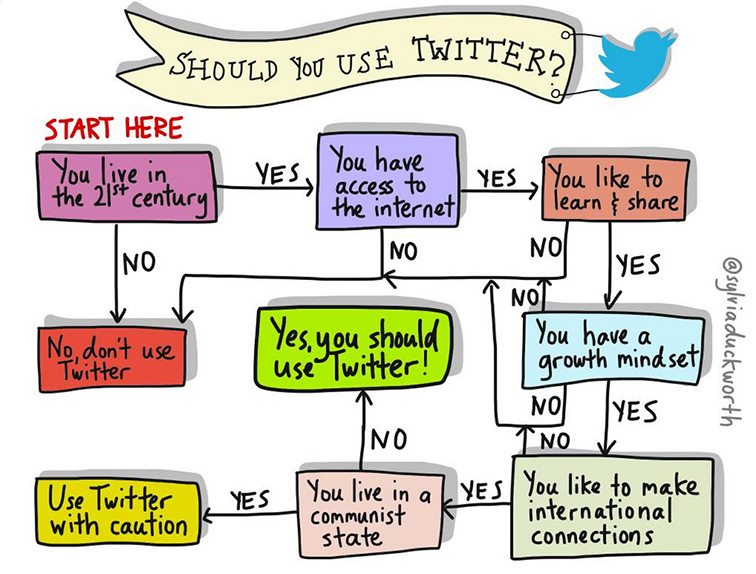
    An early social media adapter, I joined Twitter out of curiosity. I took a username related to my job, @bonedoc which was available that time. I followed friends and people who share my interests- photography, book authors, e- learning and healthcare. I once thought twitter is just for people’s bursts of trivial updates or memes. Twitter turned out to be sometimes like that and much much more. Here’s a decision tree to help you decide on whether to use twitter or not.
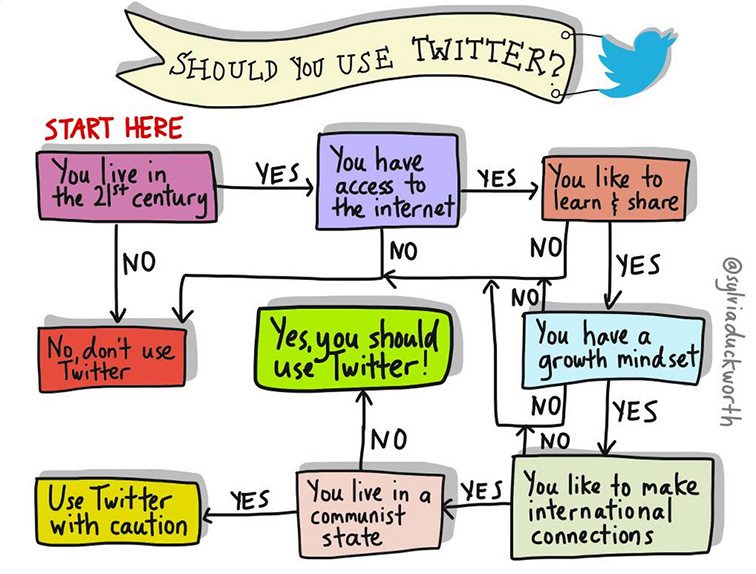
    A decision tree for using (or not) Twitter a Sketchnote by Sylvia Duckworth

    Twitter as a Learning Tool

    The qualities that make Twitter seem inane and half-baked are what makes it so powerful.”

    Jonathan Zittrain

    One can just lurk reading others’ (public) tweets. To filter noise however, you have to curate information showing up in your feed. In twitter lingo, the hashtag enables curation of tweets. Curating for me is already half of the learning part on twitter. Curating information hones your filtering, organising and analytical skills. Curating tweets according to relevance and area of interests led me to information previously unavailable to me.

    A networking tool?

    LinkedIn is for the people you know. Facebook is for the people you used to know. Twitter is for people you want to know.

    Source unknown

    Lurking and curating is just half of the fun on Twitter. Once I got comfortable with tweeps and tweets, I started tweeting my own thoughts. To whom? I began looking for my tribe or community. I thought of growing my network. I used twitter list to “categorize” the interest of the people I follow. I soon stumbled at colleagues experimenting with social media and twitter. I co- founded a social media healthcare group called #HealthXPh that mostly relies on twitter for discussing healthcare issues in the Philippines. My twitter network grew hundredfolds since then and still growing up to now.

    Improving higher order thinking skill

    Tweeting has taught me the discipline to say more with fewer words.

    Adam Grant

    Twitter also had this profound effect on my higher order thinking skills. Curation pressures you to analyse relevant but discard trivial stuff. The 140 character limited tweets forces you to distill your thoughts and replies in a concise and succinct manner. Tweeting broaden my perspectives on many issues, instilled the love for sharing ideas or collaborating with like minded individuals while respecting those whose thoughts diametrically opposed yours.
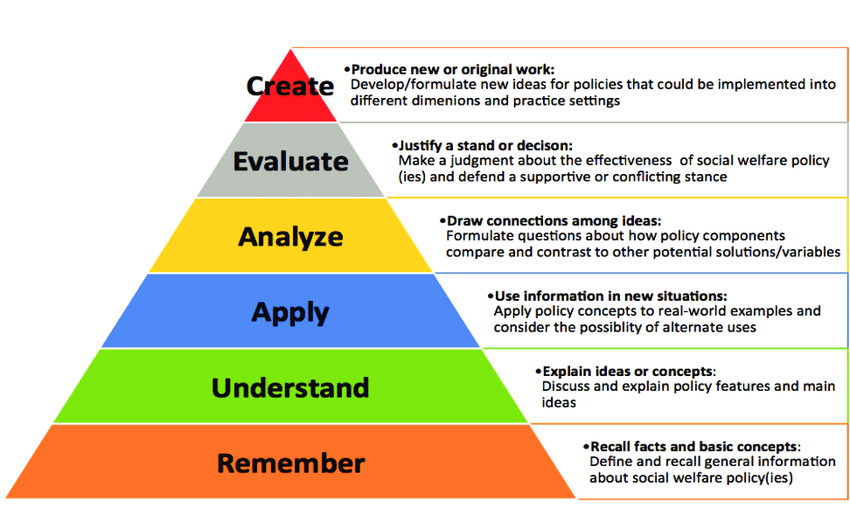
    Modified Blooms Taxonomy for Learning

    Of course Twitter is a fun and lively way to meet new people who share your interests and profession. A great majority of curating and networking on Twitter started when I joined twitter chats.

    Enter Twitter Chats

    It’s not just about consuming content, but sharing it, passing it on, and adding to it.

    “- @ariannahuff

    A Twitter chat is a virtual meeting of people engaging in a conversation about a shared topic of interest. Twitter chats are typically public chats, meaning people on twitter can view tweets in it. It is usually moderated by a host and happens live on Twitter during a pre designated, agreed upon time slot. A hashtag is used or appended to tweets in this chat, to filter conversations, allowing participants to follow the discussion. To participate, the hashtag is appended on the reply tweets

    Most Twitter chats are recurring- either weekly, monthly, quarterly, focusing on a topic introduced by a moderator. Topic is usually introduced in a blog post or any other public social media platform. The chats usually last one hour with the moderator often summarising the output of the chat. A transcript of tweets is ideally made available after the chat has ended.

    Seriously, Twitter chats for healthcare?

    Points of views that are expressed on Twitter don’t intend to offend, but rather defend and open the conversation up to everyone so that no one has to pretend.

     Germany Kent

    The idea is laughable ten years ago. If you look closely in Symplur’s healthcare hashtag project registry of healthcare twitter chats today, there are hundreds of health twitter chats. The trailblazer was the Breast Cancer Social Media Chat (#BCSM) started in 2011 by Alicia and Jody, aiming to provide credible and evidence based information to support breast cancer patients. There were published studies of the positive impact of twitter chats on patients health. A lot more studies are being published every year since then.

    #HealthXPh started a regular weekly health Twitter chat in the Philippines four years ago. This twitter chat community has since grown both in its influence and ability to impact health discussions in the country. It successfully organised and hosted four annual healthcare social media summit. #HealthXPh and its core team mentored health twitter chats and conferences in the Philippines. The best part of it is that in all these social media buzz #HealthXPh is creating, patients take active roles in it.

    In summary I just gave an overview of what is twitter, my personal story of why I profusely use twitter as a learning and networking tool. I also introduced Twitter chats as another way of impacting and influencing healthcare for the better. I leave you with this quote. This might just save (or destroy) healthcare. 🙂

    Never underestimate the power of a tweet.

    Germany Kent, You Are What You Tweet: Harness the Power of Twitter to Create a Happier, Healthier Life
  • Nudges: Motivations for Social Media Success in Healthcare.

    “Breaking down barriers to information sharing should be humanity’s collective goal, not building sand castle monuments to our achievement”- Hogan and Winter (2017)

    “Social media is just hype, a fad. It will die a natural death soon.”- Anonymous

    I’ve been blogging on five different niches since 2007. I’m advocating improving medical education, patient care, sustainable ecotourism, social innovation and research on social media. Ten years is a stretch considering how fast social media and other online tools appear on our screens. An audit of “accomplishments” with social media, should be in place right?

    “What do you get from using social media? Help people? Advance your career? Earn money?”

    Defining success in any field is never an easy task. Measuring the impact of a tool (such as social media) to that success, is even harder. If we define success as an observable change in a person or a society however, success is measurable.  It follows then that the indispensable tools impacting these changes are also measurable.

    Why am I asking these questions? Humans tend to replicate their successes and learn from their mistakes. The social, political and even economic changes we see in the 21st century occurred with the help of social media. Even healthcare, which is resistant to change, gave way to social pressures vis a vis social media.  We should be able to measure the impact of a tool to that change.  Or keep trying. 

    What’s more important to me was my motivation behind social media use.

    T1: “Did social media helped in the success of my healthcare advocacy?”

    I culled my ten years of social media practice into a series of blog post outlining how to’s of “successful social media campaigns”.  I went further with moderating chats on the impact of social media to a HCP’s clinical excellence here. The SMART metrics I outlined here seem superfluous from a healthcare professional’s perspective, but it sure did help.

    This comment by van der Linden (2017) in Nature suggest deeper engagements with both extrinsic and intrinsic motivations for social media advocacies. He suggested the reason for why advocacies last longer than viral hype.  Extrinsic motivation like the social pressures mentioned by Linden in his SMART chart below, explains the viral but short lived success of some of advocacies.

    The SMART chart by van der Linden

    This lead me to another question:

    T2: “What were my motivation(s) for using social media in a successful advocacy?”

    I looked back at some of my social media advocacies. I had varied motivations ranging from socially- desirable pledges of helping out a community, to a more intrinsic, personal ones like “learning this or that”. If I use the more extrinsic criteria like the SMART chart, I probably flunked. Medical education and patient care still needs improvement. Ecotourism is far from sustainable. Social innovations still languish and researches fail to pass even the lab doors. I can count a few more learning points from such failures but what I could not reconcile is this:

    I am still here. I’m still using social media to further advocacies- mine or someone else’s. Many of my social media friends and colleagues from the past went on to some other endeavours. Others stayed and pushed forward advocacies I can only dreamed of. This got me thinking:

    T3: “What made me/us stick to using social media for our successful advocacies?”

    Van der Linden  pointed some interesting observations. Intrinsic motivations favor more lasting and sustainable social media campaigns, along with a “yearly, recurrent event or behaviour”. I can think of the latter as akin to our weekly social media tweet chat and annual summit at #HealthXPh. The tweet chat and annual summit bound us for years.

    The intrinsic motivation is well, deeply engaging for me. “Selfish” if you think of it as pushing a personal agenda. This is however the same personal agenda, that magic that happened to many healthcare professionals I look up to professionally nowadays.

    The internet and social media made lifelong learning readily possible for me. Apart from breaking geographic, cultural and financial barriers, lifelong learning (though internet and social media) pushed both my professional and academic development, forward. I probably couldn’t quantify how much social media helped me, but I can’t imagine learning now if I have not.

    Indeed medical education needs further improvements. Social media though allowed me to expand the depth and girth of my medical knowledge beyond the halls of institutions, the paywalls of journals and the monopolies first world medicine and education. I’m learning not only from my patients but from others who share their experiences online. You help patients and colleagues beyond your limited medical/surgical skills could offer. I can name a few dozen academic and advocacy headaches that have yet to be solved even with social media around. But those I did? Those wouldn’t be possible without social media and the internet.

    Thanks to technology, we never stopped learning. To better quantify its contribution, we should have thought about success in and using social media for advocacies ten years ago. That’s the best time to adapt, in the field of medicine, healthcare and where ever applicable. The second best time is now.

    Join us this Saturday September 22 9PM Manila time for an exciting #HealthXPh tweet chat discussion on motivations for social media success in healthcare. These are our guide questions:

    • T1: “Did social media helped in the success of my healthcare advocacy?”
    • T2: “What were my motivation(s) of using social media for an advocacy?”
    • T3: “What made me/us stick to using social media for our successful advocacies?”


    References:

    Aguilar, R. (2016, April 29). Part IV: Assigning SMART metrics to social media channels [Blog post]. Retrieved from https://remomd.com/social-media/assigning-metrics-social-media-channel.html

    Aguilar, R. (2017, March 11). Metric Matrix: How should we measure the impact of social media on clinical excellence? [Blog post]. Retrieved from https://remomd.com/social-media/assigning-metrics-social-media-channel.html

    van der Linden, S. (n.d.). The future of behavioral insights: On the importance of socially situated nudges. Behavioural Public Policy, 1-11. doi:10.1017/bpp.2018.22

    van der Linden, S. (2017a), ‘The nature of viral altruism and how to make it stick’, Nature Human Behaviour, 1. 10.1038/s41562-016-0041.

    Hogan, A. M., & Winter, D. C. (2017). Changing the Rules of the Game: How Do We Measure Success in Social Media? Clinics in Colon and Rectal Surgery, 30(4), 259–263. http://doi.org/10.1055/s-0037-1604254

  • For using Facebook and other social media platforms, how much of your personal privacy are you willing to give away?

    It blew right in our face.

    The “Facebook Scandal” (FB data breach with The Cambridge Analytica) shook many industries using  this social media platform to “influence” a particular interest.

    “We exploited Facebook to harvest millions of people’s profiles. And built models to exploit what we knew about them and target their inner demons…” Christopher Wylie, the whistleblower who worked with a Cambridge University academic to obtain these data using third party app, told the Observer.

    Mark Zuckerberg & Co built Facebook to fill its users’ need for socialising, online. We all knew however, that Facebook was also created to harvest data in the first place. This is in the fine print of FB’s terms of use you’ve agreed to, when you started using Facebook.   Although the company publicly admitted using data for their own regulated and targeted advertising algorithm alone,  it may have “unknowingly” provided  “limited data” to third party companies thru the various apps. Zuckerberg apologised for the “break of trust” given to them by their users because of this. What those “third party entities” do ( or did) with these data remains a mystery to the public.

    Remember how Target “snooped” on its customers and figured out a teen girls is pregnant before her father found out? By harvesting its customers’ shopping habits and using  predictive analysis, it was able to predict the most likely “next buys” of its customers and “structured” their stores to capture that buying intention. This pregnancy prediction model predicted with 87% accuracy that a lady would soon be delivering a baby if it buys vitamins, supplements, diapers or a blue rug!  We can only hypothesise about the staggering scenarios of “what ifs” if these breached data reached a not so well intentioned party. Elections, politics or buying habits are but to name three.

    In healthcare, privacy breaches are not only considered scandalous. It is  “deadly” as well for it may cost lives.

    To be fair to Facebook, healthcare (willingly or unwillingly) benefitted from some of the platforms “allure”. The relatively inexpensive, easy, accessible and wider user base are very good reasons for educating the masses about health  issues. It is also a very good alternative to ( or in fact dismantling) more traditional, expensive media platforms for getting across messages to a wide range of users.  There are probably thousands if not millions of patient support groups in FB.  Advocacy campaigns aimed at improving healthcare abound in this platform. There are also healthcare professionals who use FB as a listening and or speaking platforms for many well intentioned campaigns. In short, the healthcare industry through its stakeholders, are also benefitting from FB’s social media clout while knowingly giving away part of its privacy. Here’s where the conundrum begin and why this breach opened a  pandora’s box in healthcare.

    Imagine, if user profiles and data went into the hands of not so well intentioned healthcare industry player. What if this data is used “shape”, influence or manipulate minds to buy a particular product? Or tinkered, to accept or debunk certain healthcare issue without the benefit of validated research and recommended protocols by the medical community? What if the data are “manipulated’ to “influence” the medical community itself? This may or may not happen and regulations are something we- the healthcare stakeholders,  have to really look at in so many different ways.

    While social media regulation is still being debated, most rely on “self regulation” on what, when or how they do things on Facebook, to prevent data from falling into the “wrong hands”. Self regulation on social media  is though balancing act itself and remains a huge challenge to many of its users. #HealthXPh believe that educating the masses about health uses of these social media platforms’ plays a key role in this balancing act. This is what #HealthXPh is discussing (on Tweetchat) this Saturday March 24, 2018 9:00PM Manila Time .

    As a patient, healthcare professional, student, policy maker, or advocate, how much of your personal privacy are you willing to “give away” for using Facebook?

    • T1. Why would you or would you not deactivate your Facebook account?
      T2. For using FB, what kind “data” are you willing to give away and why?
      T3. What are your parameters for absolutely stopping Facebook use?

    We are inviting you to a lively discussion thru a twitter chat , this coming Saturday March 24, 2018 9:00PM Manila time. Join discussion!

  • Healthcare Professionals’ Guide to Establishing a Professional, Social Media Presence

    Majority of healthcare professionals have personal social media account(s) nowadays.  None of them, use their personal accounts to engage patients online. These I learned after asking workshop participants’ if they use social media to engage patients online.

    Here are the important points I learned from the participants and workshop I gave on Establishing Social Media Presence at the 1st SKMS Post Graduate Course in St. Louis Hospital last February 17, 2018 :

    1. There’s an increasing number of patients going to the internet and social media to seek health information, join support groups and share their healthcare experiences. 
    2. Majority of healthcare professionals are on social media to update on medical healthcare news, share information or join colleagues in support groups.
    3. Healthcare professionals don’t use their personal social media accounts to engage patients online.
    4. There is confusion as to the benefits of using social media in healthcare.
    5. There is some degree of confusion on how should healthcare professionals (or healthcare institutions) respond when they are tagged in a social media posts.

    I cited several, global and ASEAN studies to support points number 1 and 2. None of the workshop participants (around 300+ of them) raised their hands when I asked if any of them is using social media to engage patients online.  I have no current local study to validate or refute this, so I’ll take point number 3 until proven otherwise.   I discussed the benefits of using a professional social media account to protect one’s reputation online and leave a positive digital footprint to impact healthcare.

    For those interested,  I will be posting my slides at my Slideshare/ LinkedIn account soon. Please visit my profile there.

    References:

    1. Patdu, Ivy. Recommendations for Social Media Use in Hospitals and Health Care Facilities. Philippine Journal of Otolaryngology Head and Neck Surgery, North America, 31, jun. 2016
    2. Marie Ennis-O’Connor (2017). Social Media: A New Dimension In Health Research [PowerPoint slides]. Retrieved from https://www.slideshare.net/ennoconn/social-media-a-new-dimension-in-health-research
    3. Pei-Li Teh & Marc Yates. 2013. Digital Health in Asia. Issue no. 4. Research Partnership. Available at https://www.researchpartnership.com/media/1182/free-thinking-digital-research-in-asia.pd
    4. Warden, Christopher. 2017 Referral MD. www.getreferralmd.com. Accessed at https://getreferralmd.com/2017/01/30-facts-statistics-on-social-media-and-healthcare/
    5. The Healthcare Social Media Shakeup. CDW Healthcare. Accessed http://www.cdwcommunit.com/resources/infographic/social-media/Massachusetts Medical Society Social Media Guide. 2015
      http://www.massmed.org/Governance-and-Leadership/Committees,-Task-Forces-and-Sections/MMS-Physicians–Guide-to-Social-Media-(pdf)/
    6. Gholami-Kordkheili F, Wild V, Strech D: The Impact of Social Media on Medical Professionalism: A Systematic Qualitative Review of Challenges and Opportunities J Med Internet Res 2013;15(8):e184
    7. Chua, ER , Calderon, PE . Ethico-Moral Responsibilities of Health Care Practitioners on Social Media. Proceedings of the DLSU Research Congress Vol 4 2016. March 7-9, 2016
    8. Isip-Tan, Iris Thiele (2014). Establishing a Professional Social Media Presence [PowerPoint slides]. Retrieved from https://www.slideshare.net/isiptan/establishing-a-professional-social-media-presence-86320762


  • Debunking fake health news on social media

    Majority of adult Americans get their news from social media according to a recent 2016 Pew Research Center study. Roughly two thirds of Facebook users get their news on this social networking site, which translates to 44% of the US general population. Forty two percent of US consumers used social media to assist in their healthcare decision making decisions. The proliferation of fake news however has sowed confusion among 63% of adult population on social media. Health and health care wasn’t spared from fake news proliferation.


    In this discussion, we hope to raise your awareness on fake health news, learn how to spot fake health news online and advocate sharing of tips on spotting fake health news to the general population. Specifically,

    • to reflect on why (or why not) fake health news on social media is a problem
    • to enumerate ways on spotting fake health news on social media
    • to identify the ways in which social media companies combat fake health news
    • to enumerate way how healthcare professionals should address fake health news on social media.

    Fake news or post truths are “type of propaganda that consists of deliberate misinformation or hoaxes spread via traditional print and broadcast news media or online social media”. It is intentionally written and published to mislead people for financial or political gains. Fake news often have “sensationalist, exaggerated, or patently false headlines” to grab the reader’s attention.


    • Activity 1. Test your fake news knowledge by answering this BBC Quiz on spotting fake news. A number of quiz items refer to fake health information online.

    Social Media as a source of trustworthy news

    Approximately 62% of US adults get their news from social media sites such as Facebook and twitter.

    Percentage of US adults who get news from social media networking sites (Source: Pew Internet Research Group)

    This is a significant increase compared to a 2012 study, which says that 49% of US adults seek news on social media sites. Interestingly a 2012 pWC Health Research Institute study showed 42% of consumers have used social media to access health-related consumer reviews and assist in their healthcare making decisions.

    Not only are US adults getting their news on social media or that social media information influences their healthcare decision making but the trust ratings for health information on social networking sites are high. A 2016 architectural approach study revealed that users perception of health information on social media is high. This confirms an older 2012 pWC study that revealed 90% of respondents age 18-24 would trust information shared by others on social networking sites.

    Recently, the proliferation of fake news online has sowed confusion among social media users. About two-in-three U.S. adults (64%) say fabricated news stories cause a great deal of confusion about the basic facts of current issues and events. Fake news and the confusion it brings is even more dangerous and potentially damaging in healthcare. One of the most shared health news on Facebook is fake health information. Can you spot this popular health misinformation?

    Are fake health news on social media a problem?

    A recent Independent (UK) article stated “how dangerous fake health news has conquered Facebook” postulating that “misinformation published by conspiracy sites about serious health conditions is often shared more widely than evidence-based reports from reputable news organisations”. Half of the 20 most shared news bearing the word “cancer” in its headline seen by a combined total of millions in 2016 were discredited by health authorities and are considered myths or fake news. The worst part of this cancer fake health news is that it is dangerously misleading.

    In what ways could social media companies combat fake health news? 

    As to when will proliferate of this fake health news on social media end, nobody knows. Facebook CEO Mark Zuckerberg has pledged efforts to curb fake news on facebook and a group of scientist and science supporters have debunk some of the more popular cancer myths on social media. Some perpetuators of fake health news fought back by spreading information about “censorship on independent journalism” by social media sites or internet gatekeepers.

    How should healthcare professionals address fake health news on social media?

    There are a few health institutions and professionals who seek out and debunk fake health news on social media. Cancer Research UK and Sense About Science are two of these institutions but fake health news continues to proliferate online.  Admittedly, not many healthcare professionals debunk (or at least voicing out their concern) fake health news on social media. This is one of the reasons why fake health news still proliferate online.


    Activity 2. Using your twitter handle (eg. @bonedoc), join the #HealthXPh chat on twitter this Saturday September 30, 2017 9:00- 10:00 PM Manila time  and reflect on the following guide questions

    • T1: Is fake health news on social media a problem? Why or why not?
    • T2: In what ways could social media companies combat fake health news?
    • T3: How should healthcare professionals address fake health news on social media?

    Send your reflections with the hashtag “#HealthXPh” anywhere inside your 140 character length tweets. Multiple tweets allowed so long as it is within the one hour time frame set by the moderator. Expect retweets and tweet-discussion with global participants.


    FactCheck.org a US non profit consumer advocate, together with The International Federation of Library Associations and Institutions (IFLA) developed an easy checklist on how to spot fake news online. This is reflected on a shareable graphic below.


    Activity 3. Using this guide, retest your fake news knowledge by answering this BBC Quiz on spotting fake news. Share your experience on this discussion by appending your thoughts/ summary on the header of this image and posting it on your social media networks.


    Summary:

    In this learning discussion, we raised your awareness on fake health information on social media, did activities to spot and debunk fake health news on social media and shared your thoughts on combating the proliferation of fake health news via social media twitter and facebook. #HealthXPh hopes that healthcare professional would play an active role in combating fake health news online.

    References: 

        1. Gottfried, Jeffrey and Shearer, Elisa ; Pew Research Center, May, 2016, “News Use Across Social Media Platforms 2016” Retrieved Sept 30, 2017 http://assets.pewresearch.org/wp-content/uploads/sites/13/2016/05/PJ_2016.05.26_social-media-and-news_FINAL-1.pdf
        2. Health Research Institute April 2012; Social media “likes” healthcare From marketing to social business Retrieved Sept 30, 2017 http://www.pwc.com/us/en/health-industries/health-research-institute/publications/pdf/health-care-social-media-report.pdf
        3. Lopez, D.M., Blobel, B. & Gonzalez, C.; Information quality in healthcare social media – an architectural approach; Health Technol. (2016) 6: 17. Accessed Sept 30, 2017 https://doi.org/10.1007/s12553-016-0131-9
        4. Andrew Griffin, Rachel Roberts; Facebook’s plan to stop fake news revealed by Mark Zuckerberg, but site will continue to promote stories it knows to be fake. Independent (UK) ; 15 December 2016 18:59 GMT Accessed Sept 30, 2017 http://www.independent.co.uk/news/uk/politics/facebooks-plan-to-stop-fake-news-revealed-by-mark-zuckerberg-facebook-changes-what-are-they-fake-a7478071.html
        5. Childs, Oliver Don’t believe the hype – 10 persistent cancer myths debunked Science Blog in Cancer Research UK March 24, 2014 Accessed Sept 30, 2017 http://scienceblog.cancerresearchuk.org/2014/03/24/dont-believe-the-hype-10-persistent-cancer-myths-debunked/