Blog

  • Peer feedback among healthcare professionals on social media

    Peer feedback among healthcare professionals on social media

    I admit, giving and receiving feedback aren’t my strongest points. All these years I gave and received all sorts of feedback – some informal, mostly formal while a few times brutal, to and from almost everyone in the industry. I can tell you that receiving and giving feedback never gets easier with time.

    Feedback is the breakfast of champions.

    Ken Blanchard

    Few weeks ago a well respected colleague and friend gave me a feedback. He underpinned a nagging problem highlighting my inefficiency as an institutional manager. My reaction? Mixed. I am so glad he pointed out the lapse and triggered a cascade of corrective measures on our part. Sad, because a very good friend decided to end his professional service with us. On top though I felt weirdly happy because someone I respected and look up to gave the feedback. I took time off to process this reaction. Is my reaction because of the person who gave the feedback or the manner in which he gave one?

    Why health care needs a feedback

    Feedback is the fuel that drives improved performance.

    Eric Parsloe

    Often incorporated into assessments, all human performance fields needed some form of feedback to improve. “Improving health outcomes and lowering cost of delivery hinge on a dynamic and regular feedback system” echoes many health experts. Feedback compels healthcare professionals and scientists to answer the most pressing problems besetting healthcare. Given properly and consistently, feedback identifies and narrows gaps in health care.

    Who gives feedback in health?

    Years back, a mentor shared a tip about improving my own “skill” of giving feedback. This is what he said:

    “Be a mirror. Listen. Most of the time that’s all you need to do”.

    Healthcare professionals value feedback from peers more than anyone else, studies have shown. Feedback helps build confidence and competence among healthcare professionals especially if it came from well respected peers. I can tell you being an orthopedic surgeon for some years, it ain’t easy receiving advise from someone who neither went under your bone drill nor is wielding one. But I am very happy. Indeed that feedback from an “outsider” changed a lot in me both personally and professionally.

    Social media feedback

    While formal assessment and feed backing happen mostly in the confines of healthcare, spillage into social media are not uncommon. Given the new culture of radical transparency and accountability, social media invariably complicates the health care feedback environment. One needed a host of new skills to be an effective feedback giver and receiver over social media. Why? Studies have shown patients and relatives value healthcare professional’s online health opinions more than anyone else. To some degree, social media postings of a healthcare professionals affect the public’s opinion on our overall competencies.

    Take the vaccine or the specialty certifying controversy. These controversies rocked the medical profession and spilled over into social media. Some of this country’s well respected medical experts sat on opposing ends of a social media debate, giving and taking feedback from each other, under vigilant public scrutiny. This public display of feedback (PDF) while undoubtedly a very healthy debate amongst peers, often befuddle the public mind. #HealthXPh previously discussed patients social media feedback in a previous tweetchat some years ago here. What picked my curiosity is how social media feedback between peers affect the personal and professional lives of healthcare professionals.

    Join #HealthXPh chat this Saturday August 31, 9:00 PM Manila time as we discuss how healthcare professionals give and receive peer feedback on social media.

    • T1: Is social media an effective platform for giving and receiving peer feedback? Explain.
    • T2: What are the challenges to giving or receiving feedback from peers on social media?
    • T3: How do you give an effective peer feedback over social media?
    • T4: How do you process a peer feedback given over social media?

    Social media is probably here to stay. So is feedback. How should healthcare professionals, give or receive feedback on social media platforms is a matter of preference. The fact remains though that improving outcomes and lowering cost of delivery hinge on a dynamic, actionable and consistent feedback system. Social media offers is an emerging platform for peer to peer feedback in healthcare

    Without any sort of feedback, there would not be a “care” in healthcare.

    Image by freepik

    Further readings:

  • Five important reasons why health leaders need social media

    Like it or not, internet and social media are part of today’s health environment. Understanding social media is key to surviving this environment. Flexible leaders harness social media to meet better health care experience for patients. Here are the five important reasons why health leaders need to learn and harness social media:

    1. A social media post made you or your institution (in)famous.

    Most unfortunate route to learning the ropes of social media. Many health leaders stumbled social media this way. Its never too late though. Stay calm. Plan a prompt, well thought out social media response strategy.

    2. You’re not health information’s sole gatekeepers anymore thanks to internet and social media.

    Gatekeepers hold the key to information and provisions of care in the 20th century. That’s not the case in this generation. Health information is accessible to many people. Some patients wants greater participation in managing their health. Fortunately, a health professional- patient partnership is not only feasible via social media. The partnership showed better health outcomes in some areas, while lowering cost of delivery in others.

    3. Your value system is in conflict with the new value system arising from internet and social media empowered generation.

    New value system with internet and social media

    We’ve hone our leadership skills and toolboxes before internet and social media. Radical transparency a value the current generation espouse, annoys many leaders. Understanding this new value system is key to providing better health care outcomes, at a reduced cost for this generation.

    4. New and social media amplified health expectations is different from what existing system provides.

    Patients expect better healthcare experience

    With readily available information and new value system comes new health care expectations. Unmet health expectations lead to clashes and divorce in health partnerships. Fragmented health systems called silos, provide irrelevant care at skyrocketing cost.

    5. Patients and their support group wanted greater participation in managing their health.

    Internet and social media made health information accessible to everyone. Providing care though, is still in the hands of trained professionals. This may not be the case for long as many patients including their family and support groups, wanted greater participation in managing their health. It’s no surprise that social media is the platform of choice. The sooner we accept this, the better prepared we are in harnessing social media for better health care.

    Social media is here to stay. I may have painted a bleak picture but there’s a way to harness social media for better health. Leaders should be flexible enough to partner with patients in this regard. It is their health after all.

  • Social Media as a tool in engaging providers’ “buy in” on health care innovation

    Compared to other industries and despite milestone discoveries that saved million of lives, innovation in health care is still considered “slow” by many. There are myriad of reasons for this but healthcare system is a complex system and for innovation to take traction, it needs to satisfy many stakeholders. Systems level solutions offers a lot of potential but it’s the stakeholders’ “buy in” (or “out”) that usually doom interventions to fail.

    What drives change and innovation in health care?

    Clarifying the direction of change helps untangle the confusion and may also improve buy in of stakeholders. Improving health outcomes and lowering the cost of health care services drives change and innovation in health. These two complementary driving force put emphasis on the Patients First intention. Many health stakeholders and most especially providers, share this altruistic goal. Lowering the barriers to stakeholders engagement maybe a solution, but what’s important is that leaders engage health care providers forward to health innovation. Moreover, health leaders should recognise that a buy in to “Patient’s First” goal doesn’t mean neglecting the motivational aspirations of health care workers. Leaders need to tap in these motivation if they expect providers to be engaged and at the forefront of change in health care. I hypothesise that social media, intertwined in todays internet heavy health care, plays a role in this.

    Health leaders should recognise that a buy in to “Patient’s First” goal doesn’t mean neglecting the motivational aspirations of health care workers. Leaders need to tap in these motivation if they expect providers to be engaged and at the forefront of change in health care.

    New media as change agents in healthcare revolution.

    As the internet is now intertwined with healthcare, there’s a movement within the system to increase patient participation in the management of his or her own health. Empowered by new technology and social media, physician- patient partnership for health is gaining headway and might just ( if not already) accelerate change in healthcare. I propose that social media be used as a tool to tap in the motivations of healthcare providers and engage them towards innovations in health. If the Patients First goals drive innovations in health, social media might possibly accelerate it. How to do this is the topic of these tweetchat conversation.

    If the Patients First goals drive innovations in health, social media might possibly accelerate it.

    -unknown

    Lee and Cosgrove (2018) borrowed Max Weber’s Four Motivational Typology for Social Action as potential intervention points for leaders to tap and engage physicians as agent of change. (See picture table below).

    Photo lifted from HBR.org’s article Engaging Doctors in the Health care Revolution; here https://hbr.org/2014/06/engaging-doctors-in-the-health-care-revolution

    I suspect this holds true for all health providers and not just physicians. My hypothesis is that social media plays a role in accelerating “buy in” vis a vis these motivational tools. Let’s start crowd sourcing ideas.

    • T1. How would social media help healthcare providers engage in a noble, shared purpose? Many healthcare institution analyse the results of their Patient Satisfaction Surveys (PSS) to improve patient services. General trends of this survey and the measures implemented to improve outcomes, are posted on the institution’s social media channels for public viewing. The same general trends and specific positive results and commendations are posted on the institutions social media channels for providers viewing. The positive commendations usually motivates providers engagement to the institution’s shared goals.
    • T2: How would social media help fulfil or satisfy providers self interest? Putting the patients welfare first resonates deeply with many health providers. Like everybody else though, many are also motivated by “job security or financial rewards” while performing their duties and responsibilities of “putting the patient’s welfare first”. Many health care professionals on social media provide a vital link between institutions and patients. These health care professionals ( “influencers”) play an important role in the HCI’s organisational structure. Moreover, patients tend to consult or opine with healthcare professionals who are visible and easily accessible online.
    • T3: How would social media help healthcare providers earn respect? Like everybody else, earning respect and peer pressure are strong driver for change among healthcare workers. Although the many worst and ugly failings of the providers are publicised online, positive feedback from patients and colleagues improves performance in the long run. In the new media age where even health workers long for transparency, faster feedback and communication social media should be a good platform.

    These are just some examples of how social media could be a tool to engage providers as agent of change in healthcare. It is neither inclusive nor perfect. If we need health providers’ buy in health care’s innovative change however, health leaders probably need to tap social media.

    Join the discussion on this topic this Saturday July 6, 2019 9:00 PM Manila Time by tweeting your thoughts with the hashtags #HealthXPh #HCSMPH2019 #HCLeadership with the following guide questions:

    • T1. How would social media help healthcare providers engage in a noble, shared purpose?
    • T2: How would social media help fulfil or satisfy providers self interest?
    • T3: How would social media help healthcare providers earn respect?
    • T4: How would social media help providers embrace tradition in the pursuit of innovative change in healthcare?

    Se you all healthcare tweeps!

  • Twitter, Tweets and Tweet Chats for Better Healthcare | #SocMed4MDs

    Twitter, Tweets and Tweet Chats for Better Healthcare | #SocMed4MDs

    Lifting lives, 140 characters at a time.

    ― Germany Kent

    What is Twitter?

    Twitter is a social networking, news, and microblogging service that allows you to send out short messages called “tweets”. A tweet can be text, links or any media – photos, video, or a GIF. Tweets used to be limited to 140 characters but this increased to 280 characters last 2018.

    Should You Use Twitter?

    You are what you tweet

    Alex Tew

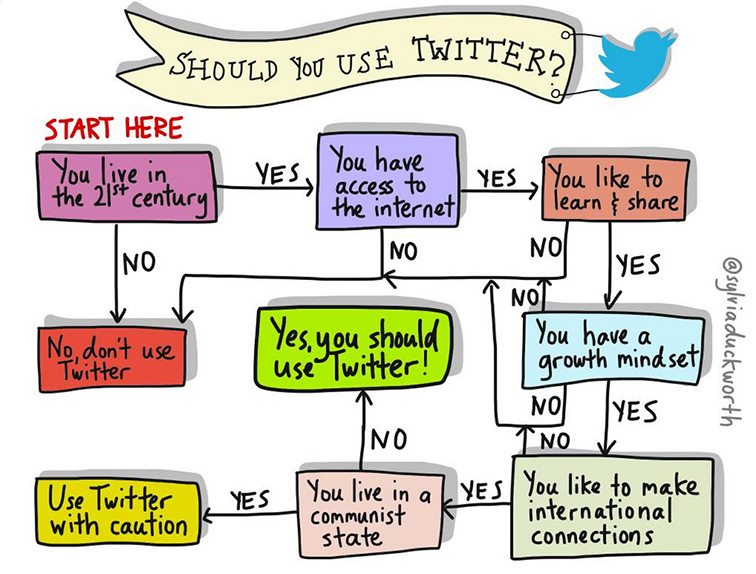
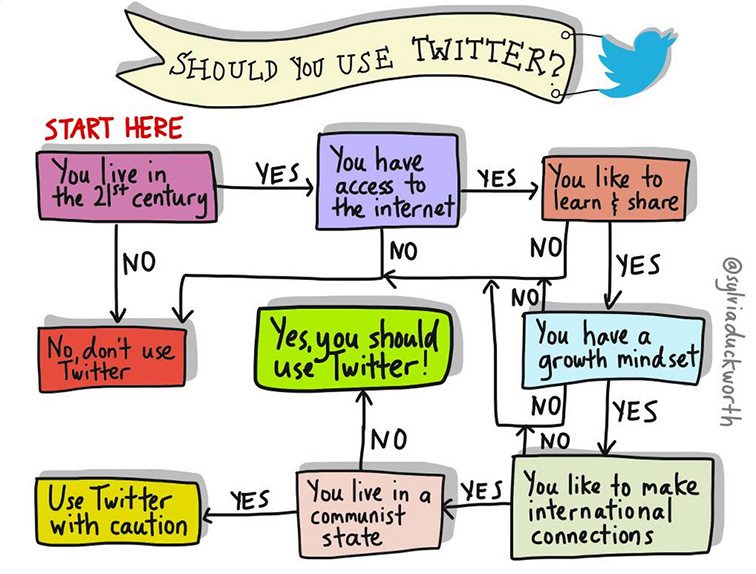
    An early social media adapter, I joined Twitter out of curiosity. I took a username related to my job, @bonedoc which was available that time. I followed friends and people who share my interests- photography, book authors, e- learning and healthcare. I once thought twitter is just for people’s bursts of trivial updates or memes. Twitter turned out to be sometimes like that and much much more. Here’s a decision tree to help you decide on whether to use twitter or not.

    A decision tree for using (or not) Twitter a Sketchnote by Sylvia Duckworth

    Twitter as a Learning Tool

    The qualities that make Twitter seem inane and half-baked are what makes it so powerful.”

    Jonathan Zittrain

    One can just lurk reading others’ (public) tweets. To filter noise however, you have to curate information showing up in your feed. In twitter lingo, the hashtag enables curation of tweets. Curating for me is already half of the learning part on twitter. Curating information hones your filtering, organising and analytical skills. Curating tweets according to relevance and area of interests led me to information previously unavailable to me.

    A networking tool?

    LinkedIn is for the people you know. Facebook is for the people you used to know. Twitter is for people you want to know.

    Source unknown

    Lurking and curating is just half of the fun on Twitter. Once I got comfortable with tweeps and tweets, I started tweeting my own thoughts. To whom? I began looking for my tribe or community. I thought of growing my network. I used twitter list to “categorize” the interest of the people I follow. I soon stumbled at colleagues experimenting with social media and twitter. I co- founded a social media healthcare group called #HealthXPh that mostly relies on twitter for discussing healthcare issues in the Philippines. My twitter network grew hundredfolds since then and still growing up to now.

    Improving higher order thinking skill

    Tweeting has taught me the discipline to say more with fewer words.

    Adam Grant

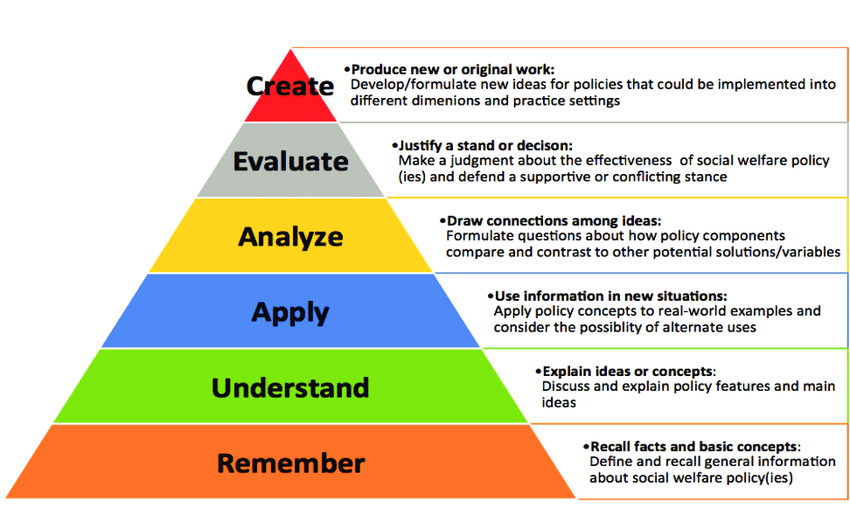
    Twitter also had this profound effect on my higher order thinking skills. Curation pressures you to analyse relevant but discard trivial stuff. The 140 character limited tweets forces you to distill your thoughts and replies in a concise and succinct manner. Tweeting broaden my perspectives on many issues, instilled the love for sharing ideas or collaborating with like minded individuals while respecting those whose thoughts diametrically opposed yours.

    Modified Blooms Taxonomy for Learning

    Of course Twitter is a fun and lively way to meet new people who share your interests and profession. A great majority of curating and networking on Twitter started when I joined twitter chats.

    Enter Twitter Chats

    It’s not just about consuming content, but sharing it, passing it on, and adding to it.

    “- @ariannahuff

    A Twitter chat is a virtual meeting of people engaging in a conversation about a shared topic of interest. Twitter chats are typically public chats, meaning people on twitter can view tweets in it. It is usually moderated by a host and happens live on Twitter during a pre designated, agreed upon time slot. A hashtag is used or appended to tweets in this chat, to filter conversations, allowing participants to follow the discussion. To participate, the hashtag is appended on the reply tweets

    Most Twitter chats are recurring- either weekly, monthly, quarterly, focusing on a topic introduced by a moderator. Topic is usually introduced in a blog post or any other public social media platform. The chats usually last one hour with the moderator often summarising the output of the chat. A transcript of tweets is ideally made available after the chat has ended.

    Seriously, Twitter chats for healthcare?

    Points of views that are expressed on Twitter don’t intend to offend, but rather defend and open the conversation up to everyone so that no one has to pretend.

     Germany Kent

    The idea is laughable ten years ago. If you look closely in Symplur’s healthcare hashtag project registry of healthcare twitter chats today, there are hundreds of health twitter chats. The trailblazer was the Breast Cancer Social Media Chat (#BCSM) started in 2011 by Alicia and Jody, aiming to provide credible and evidence based information to support breast cancer patients. There were published studies of the positive impact of twitter chats on patients health. A lot more studies are being published every year since then.

    #HealthXPh started a regular weekly health Twitter chat in the Philippines four years ago. This twitter chat community has since grown both in its influence and ability to impact health discussions in the country. It successfully organised and hosted four annual healthcare social media summit. #HealthXPh and its core team mentored health twitter chats and conferences in the Philippines. The best part of it is that in all these social media buzz #HealthXPh is creating, patients take active roles in it.

    In summary I just gave an overview of what is twitter, my personal story of why I profusely use twitter as a learning and networking tool. I also introduced Twitter chats as another way of impacting and influencing healthcare for the better. I leave you with this quote. This might just save (or destroy) healthcare. 🙂

    Never underestimate the power of a tweet.

    Germany Kent, You Are What You Tweet: Harness the Power of Twitter to Create a Happier, Healthier Life