Blog

  • Bonesetters vs. Orthopods

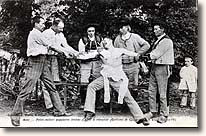
    One post operative, open fracture patient I’ve been following for weeks came to my clinic today asking me if I could remove his leg external fixator now so he can go to a “neighbor-recommended” bone setter that will “fast tract” his bone healing. A bit amused by his persistent pleadings (despite numerous occasions of explaining the need to maintain the external fixator for now), I chose another uncanny method to dissuade him.

    I told him these:

    1. that my own neighbor actually recommended a butcher to cut of his left leg and free him from all his temporary worries now.
    2. a bone setter could not possibly do any bone setting at all because his once fractured bone, is aligned already and is showing signs of healing (2-3 cortices joined already). He cannot claim what nature does beautifully and without pain now.
    3. I also told him that if the bone setter can attend to him 24 hours a day, answer all his questions via text message or calls anytime, stand on trial testifying for his “serious physical injuries” charged against those who mauled him, and then take it on stride that his services may be for free, then he can go to that bone setter now.

    That bone setter lost one more patient today.

  • Of getting lost, gold plated stethoscopes and medical careers

    “Lost”.That’s the best word to describe my general feeling the day after my graduation. I don’t know where to start my medical career. There weren’t any practical road maps to take on. I say practical because it’s frustrating trying to figure out the nitty-gritty of establishing a practice on your own! Despite swallowing voluminous medical information and bombardments of idealism sans borders, I’m still lost in the opportunities in front of me. Regurgitating medical facts you learn in the lecture halls and clinics is not an easy thing to do. Those facts I learned (and still learning it) the hard way.

    The great enlightenment so far focused on two things- that career decisions solely depend on principles, values and capabilities and that you will be entirely responsible for whatever outcomes it may bring- good or bad. There are no blueprints, only guides. No boxed in career, or prepared “road maps”. Decisions are based on your particular situation and preferences. Thus,I prefer taking matters my way- read and criticize information and then decide squarely, sooner than later if possible.

    As a general guide, you may start off with envisioning yourself 10 or 20 years from now and then on retirement. Do you see yourself still practicing medicine? Comfortably? Where and what type of community? In what field? These are some of the questions that may help you through building your career goals, a beacon perhaps. There are no right or wrong choices mind you. Having one scary goal is far better than having no goals at all.
    Having a “beacon”of your future medical career isn’t enough however. You have to assess the environment your going to “jump” in. The medical world is far more complex than you can imagine and is “harsh” by some comfortable standard. Med school has yet to learn a way to teach this real life scenarios in the clinics and lecture halls. Not to paint a bleak outlook, but a career in medicine will not be handed to you in silver platter just because you succeeded in adding the letters MD to your name. Discern the various stakeholders in the field and weigh their contributions. Read my thoughts on the stakeholders here (Five things the government wont tell you when you start your practice). You might be surprised at how much med school has isolated you from “the practice”.

    The next big question now comes, “Am I cut for a specialty?” Should I stay as a GP or study some more for a more specialized field?” I’m not going to tell you what to do, but if you Google for the medical forums in the net, there are hundred guides for you to answer this question. The bottom line is that you decide for yourself based on your goal, preferences and capabilities. Don’t be lured by fame and fortune. Some docs are superstars in their fields and flunk on another. If you still can’t decide which way to go through, you may want to read through this article “Alternative Practice Styles for Physicians” before deciding on to your career decisions. There are other careers besides being a “GP” or a “Specialist”.

    Another lingering question you probably is mulling to right now is money. “Will I earn from this profession? Or will I get rich?” In my opinion, unless you were already born into this world with stocks, bonds and mutual funds in your crib, you won’t get (filthy) rich in this profession. But you’ll live comfortable enough to feed your family and a little for your R&R. More than that, our society sees it as taboo for docs to earn more. One patient told me he was afraid of another physician who examined him with gold plated stethoscopes. I kidded I wield a scalpel and that physician is his anesthesiologist. That OR never pushed through.

    Of all the questions running in your head now, its probably “time” that bothered you the most. “How long till I get successful in this career?” Sadly, there are no definite answers to that. One thing for sure, at the beginning of your practice you’ll have plenty of time daydreaming and planning your vacations, but you don’t have the money to spend for those dreams. Once you earn and save enough for those vacations, you won’t have time to enjoy them because your darn too busy seeing patients! That the irony of a “successful” practice.

    So go ahead, listen to those prozaic speeches of grandeur and beauty of the medical world. Take a hint from them but make sure you bring in paracetamol for information headaches and AlMgOH for your empty stomach. You will need a lot of these drugs along when you traverse the road of your professional medical career! When you’re lost, don’t worry. You’re not alone.

  • An advice to our new (medical )graduates; The Blog Rounds 31st Edition

    Is it this the right career for me?Where am I now? What should I do? Where should I start my practice?Am I relevant to where I’m going to practice? Will I earn a living in this profession?

    Too late, but those are just few questions that swarm the minds of our new (medical) graduates. The doc bloggers of TBR will attempt to share our ‘answers’ to some of these questions. The 31st edition of TBR dubbed “Letter to a (Medical) Graduate” will be hosted by Doc Gigi on her blog The Last Song Syndrome. Check out her call for articles here!

    The Blog Rounds is a biweekly compilation of the best in Philippine’s medical blogosphere, written by physician bloggers (or the medically inclined bloggers) and hosted on a participating blogger’s weblog. Archives and edition schedules ( plus the host blogger) are listed here. The next edition of TBR will be up this Monday, March 9 ,2009 7am PST.

    Physicians and medically inclined bloggers interested in joining this blog carnival, please contact me through my email kokegulper[at]yahoo[dot]com or any of the participating TBR bloggers. Guidelines and updates are posted here in my website, The Orthopedic Logbook.

  • Web 2.0 tools and its (possible) use in medicine

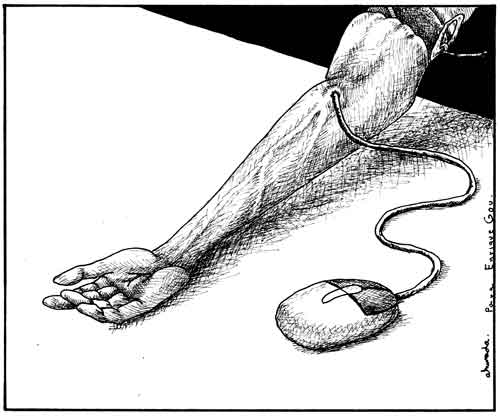
    The application of Web 2.0 to medicine spawned the term Health 2.0 and Medicine 2.0. While the use of web 2.0 tools in medicine is quite unclear, recent research on internet usage among one population is revealing. One third of the American population said they’ve used the internet for queries related to medicine and healthcare. Also, some 250,000 physicians utilized web 2.0 tools for their practice. These usage data is changing the medical environment and web 2.0 tools is taking a large role in it.

    While most physicians barely scratched the surface of web 2.0 use some of us may have been using these web 2.0 tools unknowingly. The opportunity for clinical use is yet largely untouched for some reason. Others are afraid of losing the so called “personal touch” between physicians and patients – a clear misnomer because web 2.0 will probably never replace that set up. Most physicians simply don’t have the desire to.

    Here are some of the web 2.0 tools that you might want checking out for its use on our practice.

    Wiki (Medical Wiki e. g. Ask DrWiki)
    An online collaboration of health care professionals who publish their articles, reviews and information to help end users (could be MDs or patients or both) about a certain health concern.

    Blogs
    Like this blog, is an online diary that chronicles ideas, discuss issues and publish viewpoints of a medical blogger. Publishing is almost immediate and venues for reader comments and reactions is encouraged.

    RSS (Really Simple Syndication)
    A method of rapidly receiving tidbits, summaries and news via subscription to a hundred interest sites. Acting like a filter and fine tuning the data received to where your interest lies.
    You need an RSS reader to read all these online subscription of yours.

    Podcast
    Another name for audio blogging. Recorded voice (using mainstream media) further broaden the reach and collaboration between different end users.

    Social Bookmarking
    Blogs, podcast or websites can be submitted to a social bookmarking sites like Digg to increase the likelihood of it being stumbled upon by same interest web users.

    Social Networking (e.g. Wellsphere)
    Sites for online collaboration between physicians is growing more and more with social networking. It makes communication and collaboration between like minded individual, such as physicians to create their online presence and pursue advocacies.

    Here is another example (taken from Health 2.0 Wiki) of web 2.0 use in medicine that is documented in literature.

    Purpose Description Case example in academic literature Users
    Staying informed Used to stay informed of latest developments in a particular field RSS, Podcasts and search tools[7] All (medical professionals and public)
    Medical education Use for professional development for doctors, and public health promotion for by public health professionals and the general public How podcasts can be used on the move to increase total available educational time [8] or the many applications of these tools to public health [9] All (medical professionals and public)
    Collaboration and practice Web 2.0 tools use in daily practice for medical professionals to find information and make decisions Google searches revealed the correct diagnosis in 15 out of 26 cases (58%, 95% confidence interval 38% to 77%) in a 2005 study[10] Doctors, Nurses
    Managing a particular disease Patients who use search tools to find out information about a particular condition Shown that patients have different patterns of usage depending on if they are newly diagnosed or managing a severe long-term illness. Long-term patients are more likely to connect to a community in Health 2.0[11] Public

    While web 2.0 and health 2.0 is here, its use is sometimes hampered because of issues which to some extent, web 2.0 is trying to overcome. The danger of inaccurate information and the loss of control over information tops this concern. The safety of online information is a constant subject of debates and research. But as web 2.0 evolve, perhaps the solution to these “problems” maybe apparent.
  • Obstacle to Health 2.0 in the developing nations

    A few minutes after finishing my previous post, I stumbled at one article citing the difficulties of physicians  in the developing nations in taking advantage of the internet to improve health care delivery. To quote one response from this article in an EBM Journal.

    All of this science sounds really good, doctor, but I practice in a small town where I see very poor patients. We don’t have computers and medical libraries, you know. In fact, we sometimes don’t even have electricity.


    Admittingly, the solution to this “obstacle” far extend beyond health care policies alone. Majority of our patients don’t have internet connectivity yes, but physicians should get connected and get updates. Recent studies showed physicians beginning to harness (emails, journal searches) the internet’s potential. and online collaboration between physicians has improved the quality of care we give to our patients.Maybe we can harness those potentials now.

    Other opportunities may come in too, like harnessing the powers of mobile connectivity in health since there are far more mobile phones penetratng our population than computers and internet.

    My point is this; Our poor patients may have an excuse for not harnessing the powers of internet or web 2.0. but as physicians, we don’t have that excuse. We knew better and should strive to improve our health care delivery services. At least, in my opinion, that’s how I put a mindset on harnessing the powers of web 2.0 for health.