
 By
By After more than twenty years practicing within the Philippine healthcare system, I have become less interested in technology itself and more interested in what allows useful changes to survive.
Healthcare has no shortage of new tools.
The harder question is whether those tools actually improve the work of the people taking care of patients.
Resource limitations make that question unavoidable.
When resources are limited, technology cannot simply become another layer of complexity. It has to solve a problem people already recognize.
One thing I learned from introducing new procedures and workflows is that trust usually comes before adoption.
Early in my career, I assumed good ideas spread because they were good.
Experience taught me otherwise.
People rarely adopt changes simply because someone presents a better system.
They adopt changes when they understand why it matters, when they trust the process, and when they know what happens if something does not work.
Many of the important conversations happen before implementation.
Talk to the people doing the work.
Ask what might fail.
Listen to the concerns.
Often, those concerns become the safeguards that allow change to move forward.
Showing that you have considered failure sometimes builds more trust than simply promising success.
The same applies to digital tools.
Some of the most useful digital changes I have experienced were not sophisticated.
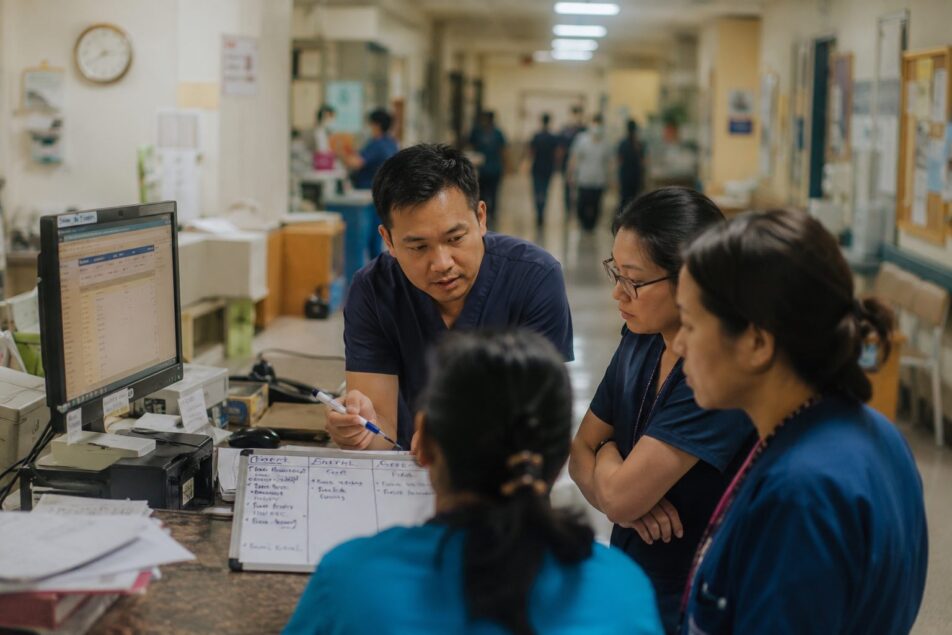
During our transition toward more digital workflows, simple tools like messaging platforms, shared imaging processes, and electronic forms solved problems clinicians already experienced.
Residents were not asking for innovation.
They were trying to find old radiographs faster.
They wanted less time searching through files and more time seeing patients.
That difference matters.
Digital adoption becomes easier when the new process removes friction from everyday work.
One mistake I have seen repeatedly is starting with technology before understanding workflow.
A complicated workflow does not automatically improve because it becomes digital.
Sometimes it simply becomes a digital version of the same problem.
Before adding technology, the better first step is usually simpler.
Watch the process.
Follow the patient.
Ask the staff.
Find where time and effort disappear.
Many improvements begin by removing something unnecessary rather than adding something new.
I learned this repeatedly in clinical practice.
Sometimes improvement came from a simple communication process.
Sometimes from a checklist.
Sometimes from a short discussion before work started.
The tool mattered less than the behavior it supported.
Starting was rarely the hardest part.
Sustaining was.
Many changes work during the first few weeks because they are new.
The real test comes later, when attention fades and people return to normal routines.
A useful system has to survive ordinary days.
One tool I wish I had learned earlier was the simple run chart.
For years, I relied heavily on experience and observation.
“I think patients are improving faster.”
“I think complications decreased.”
Sometimes those impressions were correct.
But without measurement, it was difficult to know.
A simple graph showing outcomes over time changed the conversation.
It allowed teams to discuss what was actually happening rather than depend only on memory or opinion.
Improvement became something we could examine together.
The same thinking applies to stopping old practices.
Healthcare is very good at adding things.
New protocols.
New forms.
New steps.
We are less comfortable asking whether some existing practices no longer help.
Removing something familiar can be harder than introducing something new because old routines often started for good reasons.
They represented what people believed was safest at the time.
Changing them requires respect.
Not blame.
Simply recognizing that evidence, resources, and circumstances change.
Looking back at years of trying to improve healthcare while still working inside it, the changes that lasted were usually the ones small enough for people to understand and simple enough for others to continue.
The ones built around actual problems.
The ones shared by teams rather than carried by one person.
Over time, I realized the digital part was usually the easier part.
Understanding the people, processes, constraints, and habits surrounding the technology was harder.
And probably more important.
Last modified: July 9, 2026





No comments yet.